
No products in the cart.
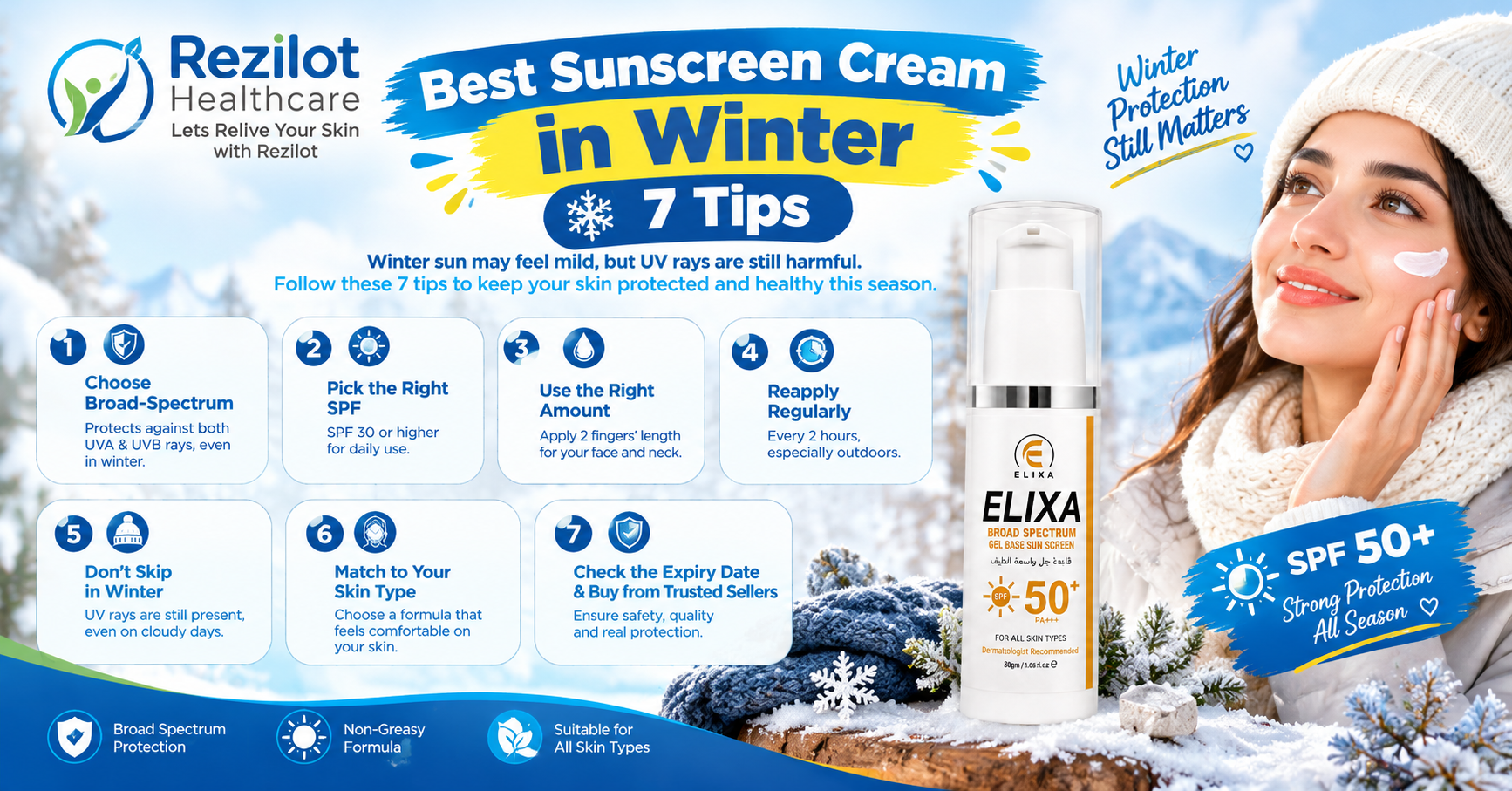
Best Sunscreen Cream in Winter: 7 Tips | Rezilot Healthcare
Most people put their sunscreen away the moment the weather turns cold. The sun feels softer, the days feel shorter, and a cosy sweater seems like all the protection your skin could ever need. Unfortunately, this is one of the most common skincare myths, and it is exactly why dermatologists and healthcare professionals keep repeating the same message: sun protection is a year-round habit. At Rezilot Healthcare, we believe that informed skin care starts with understanding what your skin actually faces every single day, in every season.
In this detailed guide from Rezilot Healthcare, you will learn why choosing the best sunscreen cream in winter matters, how winter sun differs from summer sun, which features and ingredients to look for, how to pick the right formula for your skin type, and how to apply it correctly. Whether your skin turns dry and flaky in the cold, stays oily all year, or reacts to almost everything, this article will help you make a confident, well-informed choice. By the end, you will know exactly what the best sunscreen cream in winter should offer and why Rezilot Healthcare encourages everyone to make daily sun protection part of their cold-weather routine.
Why You Need the Best Sunscreen Cream in Winter
The first question most people ask is simple: “Do I really need sunscreen when it is cold outside?” The honest answer from Rezilot Healthcare is yes, and the reasons are backed by how ultraviolet radiation actually behaves.
Ultraviolet rays do not depend on temperature. The warmth you feel in summer comes from infrared radiation, not from UV light. UV rays are invisible, they carry no heat, and they can reach your skin on a chilly, grey, or foggy day just as easily as on a hot afternoon. That is why a person can walk outdoors in December, feel perfectly cool, and still absorb a meaningful dose of skin-damaging radiation.
Here are the main reasons why the best sunscreen cream in winter deserves a place in your daily routine:
- Clouds do not block UVA rays. A large share of UV radiation passes through cloud cover, so an overcast winter sky gives far less protection than it appears to.
- Snow and bright surfaces reflect UV light. Fresh snow can reflect a very high percentage of UV radiation back toward your face, which means your skin can be exposed from above and from below.
- Premature ageing does not take a break. UVA exposure breaks down collagen and elastin, leading to fine lines, wrinkles, and loss of firmness. Winter exposure adds up over the years.
- Pigmentation and dark spots can worsen. If you are prone to melasma, tanning, or post-acne marks, winter sun can keep those concerns active.
- Cold weather weakens your skin barrier. Low humidity, wind, and indoor heating strip moisture from the skin. A damaged barrier is more vulnerable to UV stress.
- Long-term risk accumulates. Skin damage from UV exposure is cumulative. Every unprotected day, in any season, contributes to your lifetime exposure.
This is why Rezilot Healthcare recommends treating sunscreen as a daily essential, not a seasonal accessory. The best sunscreen cream in winter is simply the one that protects your skin while also respecting its need for extra comfort and moisture during colder months.
Understanding UV Rays: Why Winter Sun Still Harms Your Skin
To choose the best sunscreen cream in winter, it helps to understand what you are protecting your skin from. Sunlight reaching the earth includes two main types of ultraviolet radiation that affect the skin: UVA and UVB.
UVB rays are the primary cause of sunburn. Their intensity changes noticeably with the seasons, and they are generally weaker in winter, particularly in regions far from the equator. This is the reason many people feel they do not burn in winter and assume they are safe.
UVA rays are a different story. They stay relatively constant throughout the year and make up the larger portion of the UV radiation reaching the ground. UVA rays penetrate deeper into the skin, contribute heavily to wrinkles and pigmentation, and can pass through clouds and even through window glass. This means you can be exposed while sitting near a window at home, in the office, or inside a car.
Several winter-specific factors can raise your exposure further:
- Altitude. UV intensity increases as you go higher. If you travel to hill stations or snowy mountain areas during winter holidays, your exposure rises with every thousand metres of elevation.
- Reflection from snow and ice. Snow acts like a mirror for UV light, so skiers, trekkers, and anyone enjoying a snowy getaway face much stronger exposure than the temperature suggests.
- Low-angle sun. The winter sun sits lower in the sky and may shine directly into your face during morning and evening commutes.
- More time outdoors in daylight. Many people spend lunch breaks, school pick-ups, and weekend walks in the pleasant winter sunshine, often without any protection at all.
Because UVA is present all year, the best sunscreen cream in winter must offer broad-spectrum protection, meaning it shields against both UVA and UVB. Rezilot Healthcare always advises checking the label for this phrase, since a sunscreen that only addresses sunburn leaves the deeper, ageing-related damage unchecked.
What Makes the Best Sunscreen Cream in Winter? Key Features to Check
Not every sunscreen is suited for cold weather. A light, gel-like, or alcohol-based formula that feels refreshing in summer can leave your skin tight and flaky in winter. The best sunscreen cream in winter balances strong protection with comfort and hydration. Here is a checklist from Rezilot Healthcare to help you evaluate any product.
1. Broad-Spectrum Protection
Always choose a product labelled broad spectrum. It should protect against both UVA and UVB rays. This is the single most important feature of the best sunscreen cream in winter.
2. An SPF of 30 to 50
For everyday winter use, an SPF between 30 and 50 is suitable for most people. SPF 30 blocks roughly 97 percent of UVB rays, while SPF 50 blocks roughly 98 percent. The difference is small, but higher SPF can offer a safety margin when the product is applied thinner than recommended, which is very common in real life.
3. PA Rating for UVA Protection
SPF only measures UVB protection. The PA system, shown as PA+, PA++, PA+++, or PA++++, tells you about UVA protection. For winter, look for at least PA+++ so that the best sunscreen cream in winter you choose also protects against ageing and pigmentation.
4. A Cream or Lotion Texture
Creamy textures contain more emollients and tend to be more comfortable on cold, dry skin. A cream-based sunscreen can double as a light moisturizer, which is why many people find a sunscreen cream the more practical choice in winter compared with a gel or spray.
5. Added Moisturizing Ingredients
A hydrating base helps counter the dryness caused by cold air and indoor heating. Look for humectants and barrier-supporting ingredients, which we explain in the next section.
6. Non-Comedogenic and Fragrance-Aware Formulas
If your skin is oily, acne-prone, or sensitive, check for non-comedogenic labelling and consider fragrance-free options. Rezilot Healthcare encourages you to patch-test any new product before using it on your whole face.
7. No White Cast and Easy Blending
A product that leaves a heavy white layer is unlikely to be used daily. The best sunscreen cream in winter is the one you will actually wear every morning, so texture and finish matter as much as the numbers on the label.
Key Ingredients to Look for in the Best Sunscreen Cream in Winter
The ingredient list tells you how well a sunscreen will perform and how it will feel on your skin. Rezilot Healthcare suggests paying attention to two groups of ingredients: the UV filters that provide protection and the supportive ingredients that keep your skin comfortable.
UV Filters
- Zinc oxide and titanium dioxide are mineral filters that sit on the skin surface and reflect and scatter UV light. They are widely considered gentle, which makes them a popular option for sensitive skin.
- Avobenzone, octinoxate, octocrylene, and newer-generation filters are chemical filters that absorb UV radiation. Modern formulations often combine several filters to achieve broad-spectrum coverage with a lighter feel.
Moisturizing and Barrier-Supporting Ingredients
When shopping for the best sunscreen cream in winter, these supportive ingredients are valuable:
- Hyaluronic acid attracts and holds water in the upper layers of the skin, helping it look plump and hydrated.
- Glycerin is a classic humectant that draws moisture into the skin and keeps it soft.
- Ceramides help restore the skin barrier, which is often compromised in cold, windy conditions.
- Shea butter and plant oils add richness and reduce water loss, especially useful for very dry skin.
- Vitamin E is an antioxidant that supports the skin and helps neutralise free radicals generated by environmental stress.
- Niacinamide supports barrier function and can help with uneven tone and visible oiliness.
- Panthenol (pro-vitamin B5) soothes and calms dry, irritated skin.
Ingredients to Be Careful With
If your skin is dry or sensitive, high-alcohol formulas and strongly fragranced products may increase tightness or irritation in winter. Rezilot Healthcare recommends reading the full ingredient list and speaking with a dermatologist if you have a known allergy or a medical skin condition.
Best Sunscreen Cream in Winter for Dry Skin
Dry skin is the most common winter complaint. Cold air holds less moisture, indoor heaters reduce humidity further, and hot showers remove natural oils. The result is rough patches, flaking, tightness, and sometimes redness. For this skin type, the best sunscreen cream in winter should feel nourishing rather than drying.
Rezilot Healthcare suggests the following approach for dry skin:
- Choose a moisturizing sunscreen cream with hyaluronic acid, glycerin, ceramides, or shea butter.
- Prefer SPF 30 to 50 with PA+++ for dependable broad-spectrum protection.
- Avoid matte, oil-control, or alcohol-heavy formulas, which can leave dry skin feeling tight.
- Apply the sunscreen over a hydrating serum or a light moisturizer, and allow each layer to settle before the next.
- Pay extra attention to areas that crack easily, such as the cheeks, around the nose, lips, and the backs of the hands.
A nourishing formula keeps your skin comfortable and encourages you to use sunscreen every single day, which is the real secret behind the best sunscreen cream in winter for dry skin.
Best Sunscreen Cream in Winter for Oily and Acne-Prone Skin
It is a common belief that oily skin does not need sunscreen in winter, or that sunscreen causes breakouts. Neither is accurate. Oily and acne-prone skin still needs daily UV protection, and UV exposure can darken post-acne marks, making them last longer.
When choosing the best sunscreen cream in winter for oily skin, Rezilot Healthcare recommends:
- A lightweight, non-comedogenic formula that will not clog pores.
- Oil-free or gel-cream textures that absorb quickly without a greasy film.
- Ingredients such as niacinamide and zinc that help keep the skin balanced.
- Washing your face gently at night to remove sunscreen fully, since leftover product can contribute to congestion.
If you use acne treatments such as retinoids, benzoyl peroxide, or exfoliating acids, your skin may become more sensitive to the sun. In that case, daily sunscreen is not optional. Consult your dermatologist about the right routine for your skin.
Best Sunscreen Cream in Winter for Combination Skin
Combination skin is oily in the T-zone and normal to dry on the cheeks. In winter, the dry areas often become drier while the T-zone stays shiny. The best sunscreen cream in winter for combination skin is a medium-weight, balanced formula that hydrates without feeling heavy.
A few tips from Rezilot Healthcare:
- Look for a lotion-like sunscreen that is not too rich and not too matte.
- Use slightly more product on dry cheeks and slightly less on the oily forehead and nose.
- Try layering a hydrating serum on dry areas before sunscreen, and keep the T-zone light.
Best Sunscreen Cream in Winter for Sensitive Skin
Sensitive skin reacts quickly to temperature changes, wind, and strong ingredients. Winter can trigger redness, stinging, and irritation, so choosing the right sunscreen becomes even more important.
For sensitive skin, the best sunscreen cream in winter usually has these qualities:
- Mineral filters such as zinc oxide or titanium dioxide, which tend to be better tolerated.
- Fragrance-free and dye-free formulation with a short, simple ingredient list.
- Soothing additions like panthenol, allantoin, or colloidal oatmeal.
- Dermatologist-tested labelling where available.
Always perform a patch test on a small area, such as behind the ear or on the inner forearm, for 24 to 48 hours before applying a new sunscreen to your face. Rezilot Healthcare also advises stopping use and seeking medical advice if you notice persistent redness, swelling, or itching.
Chemical vs Mineral: Which Is the Best Sunscreen Cream in Winter?
There is no single winner in this debate. The best sunscreen cream in winter for you depends on your skin type, preferences, and tolerance. Here is a quick comparison prepared by Rezilot Healthcare.
| Feature | Mineral (Physical) Sunscreen | Chemical Sunscreen |
|---|---|---|
| Main filters | Zinc oxide, titanium dioxide | Avobenzone, octocrylene, and similar |
| How it works | Reflects and scatters UV rays | Absorbs UV rays and converts them to heat |
| Best for | Sensitive, reactive, and dry skin | Oily and combination skin, daily wear under makeup |
| Texture | Thicker, may leave a slight cast | Lighter, blends easily |
| Time to work | Works as soon as applied | Usually needs about 15 to 20 minutes |
| Winter comfort | Often creamier and more protective of the barrier | Lightweight formulas can feel less nourishing on dry skin |
Many modern products combine both types, or use micronised mineral particles to reduce the white cast. If you are unsure, start with a broad-spectrum SPF 30 or SPF 50 cream that feels comfortable on your skin, and adjust based on how it behaves through the day.
SPF and PA Rating: How Much Protection Is Enough in Winter?
Understanding labels helps you pick the best sunscreen cream in winter without guesswork.
SPF (Sun Protection Factor) indicates how well a product protects against UVB rays that cause sunburn. SPF 15 blocks about 93 percent of UVB, SPF 30 about 97 percent, and SPF 50 about 98 percent. No sunscreen blocks everything, so sunscreen should be combined with other protective habits.
PA rating reflects UVA protection. The more plus signs, the stronger the UVA protection. For daily winter use, PA+++ or PA++++ is a sensible choice.
A practical guide from Rezilot Healthcare:
- Daily indoor and commute use: SPF 30 with PA+++ is generally suitable.
- Extended outdoor time, hill stations, or snow: SPF 50 with PA++++ and water resistance is preferable.
- Skin prone to pigmentation or melasma: Choose SPF 50 and combine it with shade, a hat, and sunglasses.
Remember that the number on the bottle only works if you apply enough product. Most people use far less than the amount tested in laboratories, so their real-world protection is lower than the label suggests. That is another reason to pick a texture you enjoy applying generously.
How to Apply the Best Sunscreen Cream in Winter Correctly
Even the best sunscreen cream in winter cannot protect you if it is applied the wrong way. Follow these steps recommended by Rezilot Healthcare.
- Cleanse your skin gently. Use a mild, hydrating cleanser. Avoid very hot water, which strips natural oils.
- Apply moisturizer or serum first, if you use them. Let them absorb for a minute or two.
- Use the right amount. For the face and neck, a common guideline is about a quarter of a teaspoon, or roughly two finger-lengths of cream. For the whole body, the amount is much larger.
- Apply 15 to 20 minutes before going out. This allows the product to form an even layer and, for chemical filters, to become effective.
- Do not forget commonly missed areas. These include the ears, the sides of the neck, the back of the neck, the hands, and the area around the eyes and hairline.
- Protect your lips. Use a lip balm with SPF, since winter winds can make lips dry and vulnerable.
- Reapply when needed. If you are outdoors for long periods, reapply about every two hours, and more often after sweating, wiping your face, or spending time in snow.
- Apply makeup after sunscreen. If you wear makeup, let the sunscreen settle before applying foundation or concealer.
- Remove it at night. Cleanse thoroughly in the evening, and follow with a night moisturizer.
This routine turns the best sunscreen cream in winter into a simple habit that takes less than a minute each morning.
Common Mistakes People Make with Winter Sunscreen
Rezilot Healthcare often hears the same misconceptions. Avoiding them will make your best sunscreen cream in winter work far better.
- Skipping sunscreen on cloudy days. UVA rays pass through clouds, so cloudy does not mean safe.
- Using too little product. A thin smear gives only a fraction of the stated protection.
- Relying on moisturizer or makeup with SPF alone. These products are rarely applied in sufficient quantity to give full protection.
- Forgetting indoor exposure. If you sit near windows or drive for long hours, UVA can still reach your skin.
- Using expired sunscreen. Check the expiry date, and discard any product that has changed colour, smell, or texture.
- Choosing a summer formula for winter. Light, mattifying products may not suit dry winter skin, which is why the best sunscreen cream in winter is usually a richer, hydrating cream.
- Never reapplying. A single morning application will not last all day if you spend extended time outdoors.
- Ignoring the neck and hands. These areas show ageing early and are exposed in nearly every season.
Who Needs the Best Sunscreen Cream in Winter?
The short answer is almost everyone. Rezilot Healthcare highlights these groups in particular:
- Office-goers and commuters who spend time near windows or in vehicles.
- Students and children who play outdoors during school hours. Always choose a product that is suitable for children, and consult a paediatrician for infants.
- Men and women with pigmentation concerns, melasma, or acne marks.
- Travellers and trekkers heading to snowy or high-altitude locations.
- People undergoing skin treatments, such as peels, retinoids, or laser, who should follow their doctor’s advice carefully.
- Older adults, whose skin is thinner and more prone to damage.
- Anyone with a family history of skin conditions, who should discuss sun protection with a dermatologist.
Sun safety is not about vanity alone. It is a simple, evidence-based way to protect long-term skin health.
Beyond Sunscreen: Complete Winter Sun Protection Tips
Sunscreen is the foundation, but Rezilot Healthcare recommends combining it with a few extra habits for complete protection:
- Wear sunglasses with UV protection to guard your eyes and the delicate skin around them.
- Use a hat or scarf to cover your scalp, ears, and neck.
- Seek shade during the hours of strongest sunlight, generally late morning to mid-afternoon.
- Stay hydrated. Drinking enough water supports overall skin comfort in dry weather.
- Use a humidifier at home if indoor air is very dry.
- Take shorter, lukewarm showers and apply moisturizer right after bathing to lock in water.
- Eat a balanced diet rich in fruits, vegetables, and healthy fats to support skin from the inside.
When you combine these habits with the best sunscreen cream in winter, your skin gets layered protection against both UV damage and cold-weather dryness.
Why Trust Rezilot Healthcare for Your Winter Skin Care Needs
Choosing a sunscreen should feel simple, not confusing. Rezilot Healthcare is dedicated to helping people make informed healthcare and skin care decisions by sharing clear, reliable, and easy-to-understand guidance. Our aim is to explain what a product does, who it suits, and how to use it correctly, so that you can protect your skin with confidence.
When you explore sun care and skin care solutions through Rezilot Healthcare, here is what you can expect:
- Education first. We explain ingredients, ratings, and usage, so you understand what you are buying.
- Skin-type-focused guidance. Whether your skin is dry, oily, combination, or sensitive, Rezilot Healthcare helps you narrow down suitable options.
- A commitment to quality and responsible communication. We avoid exaggerated promises and encourage realistic expectations.
- Support for everyday healthy habits. From sunscreen to moisturizers and beyond, Rezilot Healthcare supports a complete, practical approach to skin wellness.
If you are ready to find the best sunscreen cream in winter for your skin, visit Rezilot Healthcare to explore our range of skin care products and speak with a qualified healthcare professional for personalised recommendations. [Insert Rezilot Healthcare sunscreen product name, SPF, key ingredients, and link here.]
Frequently Asked Questions About the Best Sunscreen Cream in Winter
Do I really need sunscreen in winter?
Yes. UVA rays are present all year, pass through clouds and window glass, and contribute to ageing and pigmentation. Rezilot Healthcare recommends daily sunscreen in every season.
What SPF is best for winter?
For most people, a broad-spectrum SPF 30 to 50 with PA+++ is suitable for daily winter use. If you plan to spend extended time outdoors, at altitude, or in snow, choose SPF 50 with PA++++.
Which is the best sunscreen cream in winter for dry skin?
The best sunscreen cream in winter for dry skin is a moisturizing, broad-spectrum formula containing ingredients such as hyaluronic acid, glycerin, ceramides, or shea butter. Avoid alcohol-heavy and matte products.
Can I use my regular moisturizer instead of sunscreen in winter?
Unless your moisturizer is labelled broad spectrum with a suitable SPF and is applied in the correct amount, it will not replace a dedicated sunscreen. Rezilot Healthcare suggests using a moisturizer first and sunscreen on top.
How often should I reapply sunscreen in winter?
If you stay indoors most of the day, one morning application may be enough. If you spend long periods outdoors, reapply roughly every two hours, and sooner after sweating or wiping your face.
Is sunscreen safe for sensitive skin in winter?
Many sunscreens, especially mineral and fragrance-free options, are formulated for sensitive skin. Always patch-test first, and consult a dermatologist if you have a skin condition or a history of allergies.
Conclusion: Make the Best Sunscreen Cream in Winter Your Daily Habit
Winter may feel gentle, but your skin is still exposed to UVA radiation, reflected light, dry air, and a weakened barrier. Choosing the best sunscreen cream in winter means looking for broad-spectrum protection, an SPF of 30 to 50, a PA+++ rating, and a hydrating, comfortable formula that suits your skin type. Apply it generously every morning, reapply when you are outdoors, and combine it with shade, sunglasses, and sensible moisturizing habits.
Rezilot Healthcare hopes this guide makes your decision easier and your skin care routine more effective. Protecting your skin today is one of the simplest ways to keep it healthy, even-toned, and youthful for years to come. Explore sun care and skin care essentials at Rezilot Healthcare and make the best sunscreen cream in winter a non-negotiable part of your cold-season routine.
Disclaimer: This article is for informational purposes only and does not replace professional medical advice. Please consult a dermatologist or qualified healthcare professional for personalised recommendations, especially if you have a skin condition, allergies, or are considering sunscreen for infants and young children.

Leave a Reply